
Creating The Circular Carbon Economy
Surface Water Filtration
Biochar as a Filter Mechanism to Capture Pollution from Rainwater and Surface Water
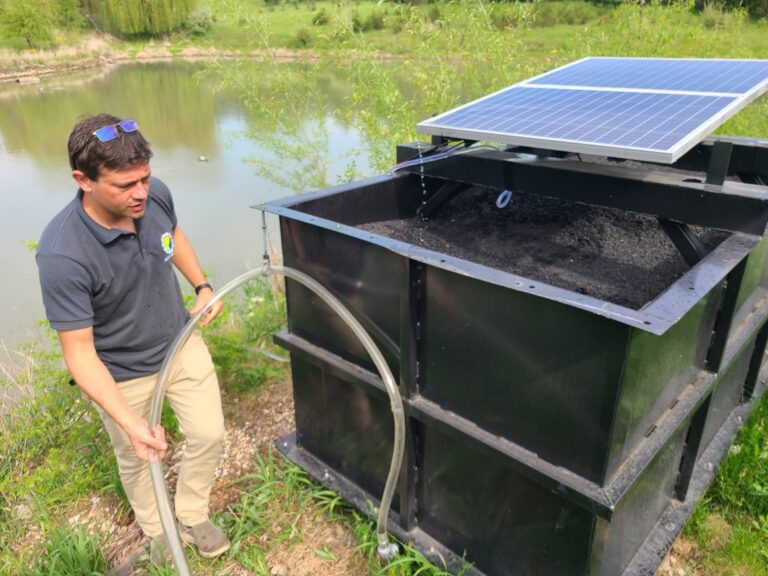
Biochar is an excellent filtration medium and can be used in simple catchment chambers to intercept a wide range of pollutants fro rainfall and surface water run-off. It has applications in the redesign of city water management as well as in cutting pollution from agriculture.
The role of Biochar here is not firstly to capture Carbon, but to use its structure to intercept a wide range of undesirable particles and chemicals from entering the environment.
- Fact Sheet
- Calculator
- Co-Benefits
- More Information
Biochar can be engineered to capture specific types of pollution, based on the number and size of its internal pore structure. It can be produced in large quantities at relatively low cost from locally availble waste materials.
Where the pollutants are organic, for example in therun-off from farms, the fact that the biochar traps what are essential nutrients, means tha once it is saturated, it can be co-composted and applied to land, reducing the need for artificial fertilizers.
Where the pollutants are potentially toxic, such as in industrial areas or from highway run-off, the saturated filter material can be re-pyrolysed and up to 90% of it re-used, or can be incorporated in a construction material such as concrete or asphalt.
The frequency of the need to change the filter material will depend on the levels and type of contamination present in the water flow.
Please be aware that the results shown at the calculator pages are more estimations than exact values.
They are ment to give you a first impression and give some numbers as basis for creating ideas.
Controlling pollution, protecting aquatic habitats and water quality.